
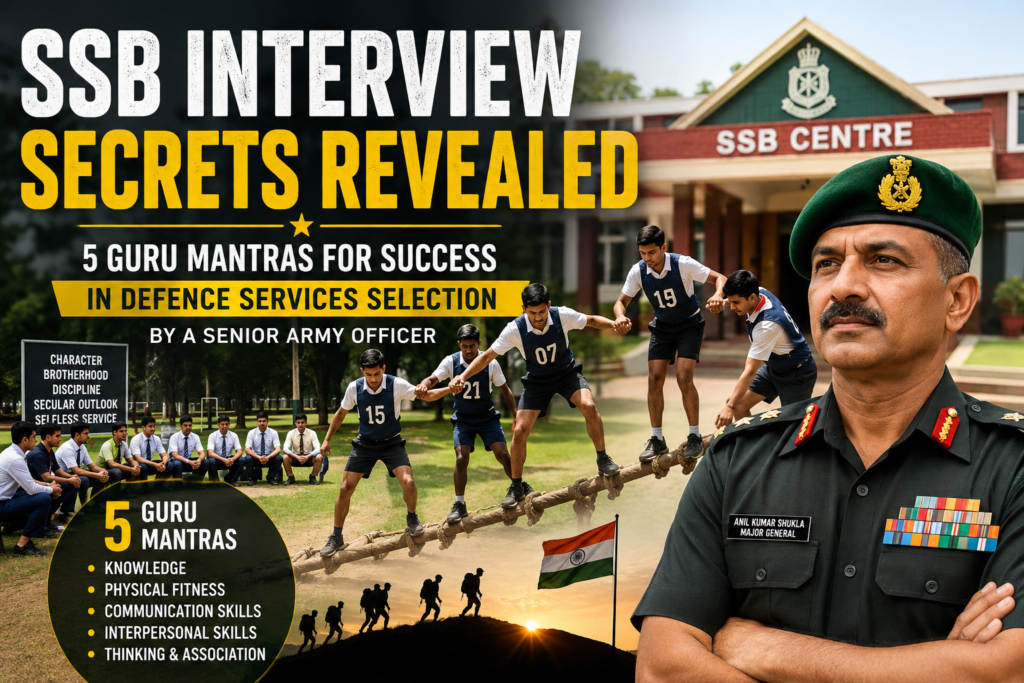
SSB Interview Preparation: What Really Matters?
The Services Selection Board (SSB) interview is one of the most respected and challenging personality assessment systems in India. Thousands of aspirants dream of joining the Indian Armed Forces through entries such as NDA, CDS, AFCAT, TES, and Technical Entries, but only a few understand what SSB assessors actually look for.
In a detailed interaction of a former SSB assessor and senior officer of the Indian Army (Major General), shared valuable insights into the realities of the SSB process, common myths, mistakes made by candidates, and the qualities that lead to recommendation.
According to him, SSB is not a test of tricks, coaching methods, or rehearsed answers. It is a scientific assessment of personality, leadership potential, responsibility, and trainability.
Myth vs Reality: Does Assessment Start at the Railway Station?
One of the most popular myths among SSB candidates is that assessment begins the moment they arrive at the railway station or reporting venue.
Senior SSB Officer (Retired) categorically rejects this belief.
He explains that formal assessment begins only within the SSB Board through structured psychological tests, GTO tasks, and interviews. Candidates should not waste energy worrying about imaginary evaluations at railway stations, buses, hotels, or waiting rooms.
Why SSB Is One of the Most Transparent Selection Systems
A major highlight of the Senior SSB Officer’s explanation is the transparency of the SSB selection process.
Three independent assessors evaluate every candidate:
- Interviewing Officer (IO)
- Group Testing Officer (GTO)
- Psychologist
Each assessor works independently and remains unaware of the detailed assessments conducted by the others. This prevents bias and ensures fairness.
Even during the final conference, assessors respect each other’s professional judgment. No individual, including the Board President or Commandant, can force another assessor to change his assessment.
This system ensures that selection is based purely on merit and personality.
Do Defence Officers’ Children Get Preference in SSB?
Another widespread misconception is that candidates from military families enjoy an advantage.
According to the Senior SSB Officer (Retired), this belief is completely false.
Why the Myth Is Incorrect
- The Armed Forces currently face a shortage of officers. If recommendations or family background influenced selection, such shortages would not exist.
- Selection is entirely merit-based.
- Children of defence officers are sometimes expected to possess greater awareness about military life, making assessment more demanding rather than easier.
He cites examples where the highest honours during military training, including the prestigious Sword of Honour, have been awarded to candidates from ordinary backgrounds, including sons of auto-rickshaw drivers.
The message is clear: merit, not family background, determines success.
The Truth About SSB Coaching Centres
One of the strongest messages from Senior SSB Officer (Retired) concerns coaching institutes.
How Coaching Can Hurt Performance
According to him, many coaching centres negatively impact candidates by:
- Destroying originality
- Creating unnecessary fear about SSB
- Promoting artificial behaviour
- Reducing natural confidence
- Encouraging scripted responses
He believes that nearly 90% of candidates become confused after excessive coaching because they start acting instead of being themselves.
Limited Benefit of Coaching
Coaching may help candidates understand the procedure and schedule of SSB, but it cannot transform personality in 10–15 days.
SSB is designed to identify genuine personality traits, not rehearsed performances.
The Importance of Originality in SSB
A recurring theme in the Senior SSB Officer’s advice is originality.
Candidates often fail because they try to become the “ideal candidate” instead of presenting their real selves.
SSB assessors are trained to identify inconsistencies between:
- Psychological tests
- Group behaviour
- Interview responses
- Personal Information Questionnaire (PIQ)
When candidates attempt to fake qualities, contradictions emerge quickly.
The best strategy is to remain natural, honest, and confident.
Understanding Trainability in SSB
What Is Trainability?
Trainability refers to a candidate’s ability to be shaped into an effective military officer through training.
The Senior SSB Officer (Retired) compares young candidates to soft clay that can be moulded easily.
This is one reason why NDA candidates aged 16–18 years are considered highly trainable.
Why Trainability Matters
Assessors evaluate:
- Learning ability
- Adaptability
- Leadership potential
- Capacity for growth
- Willingness to improve
Trainability does not mean older candidates cannot be selected. Rather, assessors examine whether candidates possess sufficient potential for future development.
The Five Guru Mantras for SSB Success
According to the Senior SSB Officer (Retired), these five principles are not only important for SSB but for life itself.
1. Increase Your Knowledge
Read extensively.
Focus on:
- Books
- Newspapers
- Current affairs
- Practical learning
Knowledge is acquired not only by reading but also by observing, listening, discussing, and doing.
2. Maintain Physical Fitness
Physical fitness reflects discipline and self-management.
Candidates should:
- Exercise regularly
- Play sports
- Maintain stamina
- Develop healthy habits
Fitness cannot be achieved in a few weeks; it requires long-term commitment.
3. Improve Communication Skills
Many candidates possess good knowledge but fail to express it effectively.
Develop the ability to:
- Speak clearly
- Present ideas logically
- Participate in discussions confidently
- Explain opinions effectively
Communication is a critical leadership skill.
4. Develop Interpersonal Skills
Modern technology has reduced face-to-face interaction.
SSB places significant importance on:
- Teamwork
- Cooperation
- Social behaviour
- Relationship-building
Learn to work with others and contribute positively in group situations.
5. Improve Your Thinking and Association
Your environment influences your personality.
Candidates should:
- Read quality books
- Maintain positive company
- Develop organised thinking
- Build constructive habits
Good friends and healthy influences help shape strong leadership qualities.
Why PIQ (Personal Information Questionnaire) Is Extremely Important
General Shukla describes the PIQ form as one of the most important documents in SSB.
The Interviewing Officer develops an initial picture of the candidate through this form.
Common PIQ Mistakes
1. Casual Filling
Never fill information carelessly.
Research facts properly before writing them.
2. Incorrect Units
Avoid mistakes such as:
- Writing height in feet when centimetres are required
- Writing annual income instead of monthly income
3. Excessive Cutting and Overwriting
Messy forms create a negative impression.
Corrections should be clean and minimal.
4. Exaggeration and False Information
Never mention hobbies, achievements, or activities that are not genuine.
Assessors can easily identify exaggeration during interviews.
What If You Have No Hobby?
Many candidates panic when they cannot identify a hobby.
General Shukla’s advice is simple:
If you do not have a hobby, do not invent one.
Honesty is always better than false claims.
Candidates should never fill hobbies merely to impress the interviewer.
A genuine candidate with simple interests is far more credible than someone who exaggerates achievements.
Does Handwriting Matter in SSB?
Yes, it does.
Although beautiful handwriting is not mandatory, the way you fill your PIQ reflects:
- Seriousness
- Organisation
- Discipline
- Attention to detail
Untidy writing, excessive overwriting, and careless presentation can create a poor first impression.
Why Candidates Fail in SSB
Senior SSB Officer (Retired) identifies several major reasons for failure:
Lack of Originality
Candidates attempt to imitate ideal officer-like behaviour instead of being themselves.
Negative Influence of Coaching
Over-coaching often creates confusion and artificiality.
Late Preparation
Many candidates start preparing only after receiving the SSB call letter.
Personality development requires years, not days.
False Information in PIQ
Exaggerated achievements and fabricated hobbies frequently lead to rejection.
Poor Communication Skills
Candidates struggle to express their ideas effectively.
Weak Interpersonal Skills
Lack of teamwork and social interaction affects performance.
Lack of Responsibility
Assessors look for responsible individuals who demonstrate maturity in daily life.
Practical Knowledge and Effective Intelligence
General Shukla strongly advocates practical knowledge over rote learning.
How to Improve Practical Knowledge
- Perform NCERT practical activities yourself.
- Observe real-life situations.
- Interact with people.
- Solve everyday problems creatively.
- Learn through experience.
Effective intelligence means using available resources to solve problems efficiently.
This quality is highly valued during SSB tasks.
Sense of Responsibility: The Hidden Officer-Like Quality
One of the most important qualities in SSB is responsibility.
According to General Officer, responsibility develops through daily habits such as:
- Helping family members
- Respecting parents and teachers
- Following rules voluntarily
- Taking initiative
- Being dependable
An officer is expected to lead by example, and leadership begins with personal responsibility.
When Should SSB Preparation Begin?
The answer is simple:
The day you decide to join the Armed Forces.
General Officer believes personality development starts in childhood and continues throughout life.
Candidates should focus on:
- Character building
- Discipline
- Reading habits
- Physical fitness
- Communication skills
- Social interaction
- Responsibility
SSB preparation is not a short-term course but a long-term process of becoming a better individual.
Final Thoughts
The Senior Ex SSB Officer’s message is refreshingly simple: SSB is not looking for extraordinary superheroes. It is looking for honest, responsible, trainable, and balanced individuals who possess leadership potential.
Success in SSB does not come from memorising model answers or attending expensive coaching programmes. It comes from developing strong character, practical intelligence, communication skills, physical fitness, and a genuine sense of responsibility.
For every defence aspirant, the ultimate lesson is clear:
Be original, be honest, stay disciplined, and focus on becoming a better person every day. The recommendation will follow naturally.
Know more on the SSB Interview success matter
SSB Interview Tips, SSB Preparation Strategy, Major General Anil Kumar Shukla SSB Advice, SSB Guru Mantra, How to Clear SSB Interview, PIQ Form Tips, SSB Coaching Myth, NDA SSB Preparation, Officer Like Qualities, SSB Interview Secrets, Trainability in SSB, SSB Selection Process, Defence Aspirants Guide, SSB Conference Process, Personality Development for SSB
- Your Mind Is a Sleeping Genie: 7 Surprising Lessons About the Power of the Subconscious Mind
 The Beta-State Trap: Why We Keep Running but Sometimes Stay… Read more: Your Mind Is a Sleeping Genie: 7 Surprising Lessons About the Power of the Subconscious Mind
 - How to Improve Brain Power Naturally: 15 Science-Backed Habits to Boost Memory, Focus and Mental Performance
 In today’s fast-moving digital world, improving brain power has become… Read more: How to Improve Brain Power Naturally: 15 Science-Backed Habits to Boost Memory, Focus and Mental Performance
 - Mount Kailash Mystery Explained: Why the World’s Most Sacred Mountain Remains Unclimbed
 In a world where humans have conquered Mount Everest, reached… Read more: Mount Kailash Mystery Explained: Why the World’s Most Sacred Mountain Remains Unclimbed
 - Mastering the Art of Dangerous Confidence: Life-Changing Lessons to Build Unshakable Self-Belief
 Confidence is one of the most powerful qualities a person… Read more: Mastering the Art of Dangerous Confidence: Life-Changing Lessons to Build Unshakable Self-Belief
 - Fueling the Mind: The Complete Guide to Brain Health, Memory and Mental Performance
 Why Your Brain Needs the Right Fuel In today’s fast-paced… Read more: Fueling the Mind: The Complete Guide to Brain Health, Memory and Mental Performance
 - Beyond Degrees: 5 High-Growth Careers Dominating the 2026 Job Market
 The New Reality of Employment: Why Degrees Alone Are No… Read more: Beyond Degrees: 5 High-Growth Careers Dominating the 2026 Job Market
 - SSB Interview Secrets Revealed : 5 Guru Mantras for Success in Defence Services Selection
 SSB Interview Preparation: What Really Matters? The Services Selection Board… Read more: SSB Interview Secrets Revealed : 5 Guru Mantras for Success in Defence Services Selection
 - Colour Codes of Roads of India
 Article: What do the colours of milestone stones on Indian… Read more: Colour Codes of Roads of India
 - The Science of Gratitude: How Kindness, Compliments & Social Connection Improve Your Health
 In a fast-paced, stress-driven world, people often overlook one of… Read more: The Science of Gratitude: How Kindness, Compliments & Social Connection Improve Your Health
 - SVAMITVA Scheme: Get Digital Identity Card of Your Landed Property| Complete Guide 2026
 India’s villages are the heart of the nation, but for… Read more: SVAMITVA Scheme: Get Digital Identity Card of Your Landed Property| Complete Guide 2026
 - Prime Minister Internship Scheme (PMIS): Complete Guide to Learn, Earn & Grow
 India is rapidly moving towards becoming a skill-driven economy, and… Read more: Prime Minister Internship Scheme (PMIS): Complete Guide to Learn, Earn & Grow
 - Banking IBPS Recruitment Examinations Schedule and Notification 2026
 Comprehensive Guide Banking Recruitment Examinations — Full Calendar 2026 Notifications,… Read more: Banking IBPS Recruitment Examinations Schedule and Notification 2026
 - Best Tech Careers in 2026: High Paying, Growth & Stability (Complete SEO Guide)
 Choosing the right tech career in 2026 is no longer… Read more: Best Tech Careers in 2026: High Paying, Growth & Stability (Complete SEO Guide)
 - The Morning Routine of High Performers: How Top Minds Prime Their Brain Before 9 AM
 You wake up. Your phone buzzes. Emails, notifications, news —… Read more: The Morning Routine of High Performers: How Top Minds Prime Their Brain Before 9 AM
 - Will Babies Be Born in Laboratories in the Future?
 Artificial Wombs, AI Monitoring, and the Emerging Vision of Ectogenesis… Read more: Will Babies Be Born in Laboratories in the Future?
 - India’s Engineering Education Paradox (2019–2025)
 Degrees in Abundance, Employability in Crisis — and the Urgent… Read more: India’s Engineering Education Paradox (2019–2025)
 - 5 Proven Ways to Improve Your Memory – Backed by Neuroscience
 Memory is one of the most fascinating functions of the… Read more: 5 Proven Ways to Improve Your Memory – Backed by Neuroscience
 - Boost Your Memory FAST with These 4 Brain Secrets!
 Neuroscience isn’t just for scientists in labs—it’s for everyone who… Read more: Boost Your Memory FAST with These 4 Brain Secrets!
 - The Art of Ignoring: 8 Powerful Ways to Attain Success and Inner Peace
 Introduction: Chanakya’s Timeless Wisdom आचार्य चाणक्य (Acharya Chanakya), in his… Read more: The Art of Ignoring: 8 Powerful Ways to Attain Success and Inner Peace