The Beta-State Trap: Why We Keep Running but Sometimes Stay in Place
Modern life keeps the mind constantly active. Notifications, deadlines, financial responsibilities, professional pressure and an endless flow of information can leave little space for mental stillness.
The brain can be compared metaphorically to hardware, while the mind represents the patterns, beliefs, memories and thought processes that operate through it. When these mental patterns are dominated by stress, fear or self-doubt, simply working harder may not always produce better results.
Understanding how conscious and subconscious processes influence behaviour can help explain why some habits are difficult to change and why clearly defined goals can make a difference.
The following seven lessons explore this idea from the perspectives of psychology, habit formation, meditation, visualization and ancient Indian wisdom.
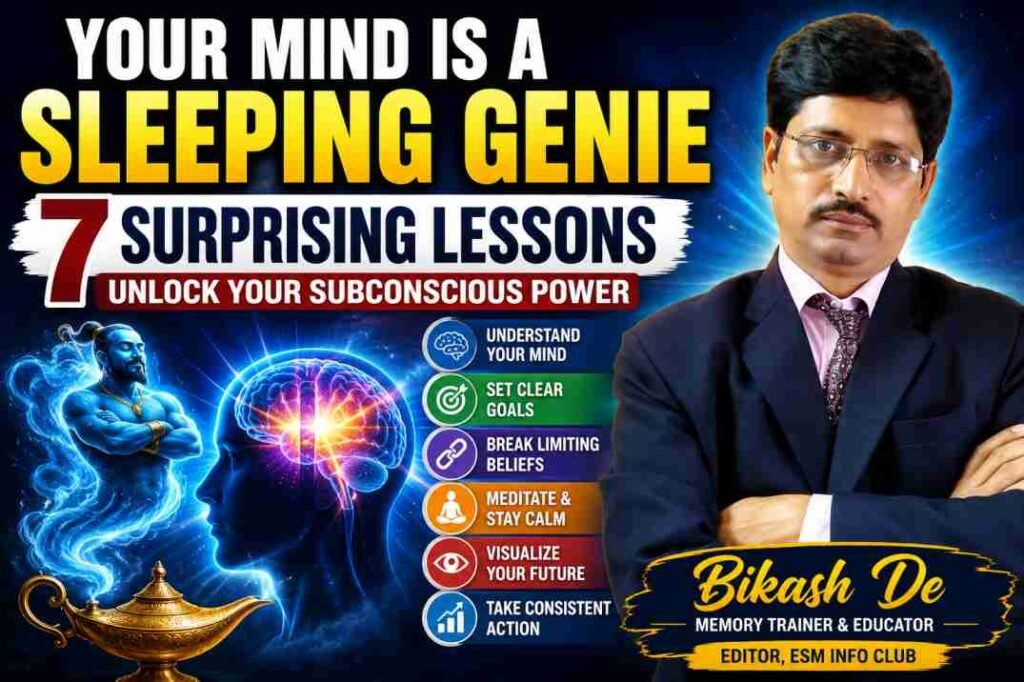
The Aladdin Metaphor: Who Is Actually in Charge?
The classic story of Aladdin and the Magic Lamp provides a useful metaphor for understanding conscious and subconscious processes.
Think of the three elements this way:
- The Lamp represents the brain, the physical organ.
- Aladdin represents the conscious mind, which makes deliberate decisions and directs attention.
- The Genie represents the subconscious mind, including deeply established habits, memories, emotional associations and automatic responses.
The metaphor highlights an important principle: not everything the human mind does is controlled consciously.
A large part of everyday behaviour happens automatically. Driving a familiar route, typing frequently used words, responding emotionally to familiar situations and following established routines can all occur with relatively little conscious effort.
This is why changing deeply established habits can be difficult. A conscious decision such as “I will stop doing this” may compete with years of automatic conditioning.
The practical lesson is simple: clear intentions need to be supported by consistent mental and behavioural patterns.
The Logic Trap: Use Reason Before the Decision
Logic and emotional commitment play different roles in goal achievement.
Before choosing an important goal, rational analysis is essential. Questions about resources, time, skills, risks and realistic possibilities should be considered carefully.
Once a decision has been made, however, excessive second-guessing can become counterproductive.
For example, someone may decide to prepare for a competitive examination after analysing the requirements and creating a realistic plan. If every small difficulty afterward becomes a reason to question the entire decision, progress can repeatedly stop and restart.
This creates a cycle:
Decision → Doubt → Withdrawal → Regret → New Decision → Doubt
A better approach is:
Analyse carefully → Decide → Plan → Act consistently → Review objectively
Goals do not necessarily have to be abandoned simply because they take longer than expected. Sometimes the solution is to modify the timeline, strategy or intermediate milestones rather than abandoning the ultimate objective.
A major goal may therefore become more achievable when divided into smaller, believable steps.
The Elephant Chain: How Old Beliefs Can Control Present Behaviour
An elephant-chain metaphor is often used to describe limiting beliefs.
Imagine an elephant that is tied with a strong chain when it is very young. After repeatedly being unable to escape, it may eventually learn that pulling against the restraint is useless.
When the elephant becomes stronger, a much weaker restraint may be enough to keep it in place—not because the restraint is physically unbeatable, but because the learned expectation has changed its behaviour.
Human beings can develop similar psychological patterns.
Repeated messages such as:
- “You cannot do this.”
- “You are not intelligent enough.”
- “People like us don’t succeed.”
- “You always make mistakes.”
- “This is impossible.”
can contribute to negative self-beliefs, particularly when they are repeatedly experienced during formative years.
However, such beliefs are not permanent programming. Human behaviour is capable of change through learning, experience, deliberate practice and repeated exposure to new patterns.
A Simple 21-Day Practice
A structured exercise can be used to challenge an unwanted belief:
1. Identify the belief
Write down the thought that repeatedly limits action.
2. Question its evidence
Ask: Is this absolutely true? What experiences contradict it?
3. Create a constructive alternative
Replace an absolute negative statement with a realistic and actionable one.
For example:
“I am not capable of learning this.”
can become:
“I can improve this skill through deliberate practice.”
4. Repeat consistently
Write or repeat the new statement regularly while simultaneously taking practical action.
The popular 21-day rule can be used as a motivational framework, but it should not be treated as a scientifically guaranteed period for permanently changing every habit. Different behaviours require different amounts of time and repetition.
The Power of Writing: Think It, Ink It, Link It
Writing down a goal can make it more concrete.
A vague thought such as:
“I want to become successful.”
contains little actionable information.
A clearer goal might be:
“I will complete three hours of focused study every weekday for the next three months.”
The second statement provides greater clarity about what, when and how.
Writing goals can also encourage people to monitor progress and repeatedly bring important objectives into conscious attention.
A useful framework is:
Think it → Ink it → Link it → Act on it
- Think it: Define the objective.
- Ink it: Write it down.
- Link it: Connect it with a practical routine.
- Act on it: Take measurable steps consistently.
The final stage is crucial. A written goal without corresponding action remains only an intention.
Meditation and the Shift from Stress to Relaxation
Constant mental activity can keep the body in a state of heightened alertness.
Stress activates physiological systems associated with the fight-or-flight response. Relaxation practices such as meditation, slow breathing and mindfulness can help promote a calmer physiological state.
Brain activity is sometimes described using frequency bands such as Beta, Alpha and Theta. These terms are useful for discussing different patterns of brain activity, but they should not be interpreted as simple switches between “bad” and “good” states.
For example:
- Beta activity is commonly associated with alert, active thinking.
- Alpha activity is often associated with relaxed wakefulness.
- Theta activity can occur during drowsiness, certain stages of sleep and some meditative states.
Meditation should therefore not be viewed as a magical method for changing biological age or automatically repairing the body.
Its more practical benefits may include helping develop attention, relaxation, emotional regulation and awareness of thought patterns.
Even a modest daily meditation practice can become valuable when maintained consistently.
The Vision Board: Turning Vague Dreams into Definite Goals
Visualization can be useful because it gives the mind a clearer representation of an objective.
Instead of simply thinking:
“I want a better future,”
a vision board can represent specific aspirations such as:
- completing an examination,
- obtaining a qualification,
- building a business,
- purchasing a home,
- travelling to a particular destination,
- improving physical fitness,
- developing a professional skill.
The important element is clarity.
However, claims that visualization alone produces a fixed success rate, or that adding a vision board automatically increases success to a specific percentage, should be treated cautiously. There is no universal scientific formula such as 10% versus 90% success.
Visualization becomes more useful when combined with planning and action.
A powerful sequence is:
Visualize → Plan → Act → Measure → Improve
The vision provides direction; the plan provides structure; action creates results.
Beyond Material Goals: The Patanjali Perspective
The discussion of mental mastery can also be connected with the ancient Patanjali Yoga Sutras.
Patanjali’s system of Ashtanga Yoga, traditionally described through eight limbs, includes:
- Yama – ethical disciplines
- Niyama – personal observances
- Asana – posture
- Pranayama – regulation of breath
- Pratyahara – withdrawal of the senses
- Dharana – concentration
- Dhyana – meditation
- Samadhi – deep absorption
One of the foundational statements of the Yoga Sutras is:
“योगश्चित्तवृत्तिनिरोधः”
It is commonly translated as “Yoga is the cessation or restraint of the fluctuations of the mind.”
This perspective shifts the focus from simply using the mind to obtain external achievements toward understanding and mastering the mind itself.
The traditional concept of Siddhis also appears in the Yoga Sutras. These are described as extraordinary attainments associated with advanced yogic practice. They should not, however, be confused with scientifically established abilities or guaranteed outcomes.
The deeper lesson is that mental development can be viewed as a journey beyond achievement alone—toward self-awareness, discipline, concentration and inner stability.
Conclusion: From Mental Noise to Mental Mastery
The human mind is far more complex than a simple conscious command system. Habits, memories, emotions, beliefs and automatic responses continuously influence behaviour.
The metaphor of a “sleeping Genie” can nevertheless provide a useful way to think about this relationship.
The key lessons are:
- Understand the difference between conscious intention and automatic behaviour.
- Use logic carefully before making important decisions.
- Question limiting beliefs instead of automatically accepting them.
- Write clear goals and connect them with practical action.
- Use meditation and relaxation to develop greater mental calm and awareness.
- Use visualization as a planning aid rather than a substitute for action.
- Explore deeper traditions of concentration and self-awareness, including the teachings of Patanjali.
The subconscious mind is not literally a magical Genie, and there is no scientific evidence that thoughts alone can automatically “manifest” any desired reality.
But one idea remains powerful: what we repeatedly think, practise and reinforce can influence what we eventually do automatically.
The real transformation therefore begins not with wishing harder, but with thinking clearly, choosing consciously, practising consistently and acting deliberately.