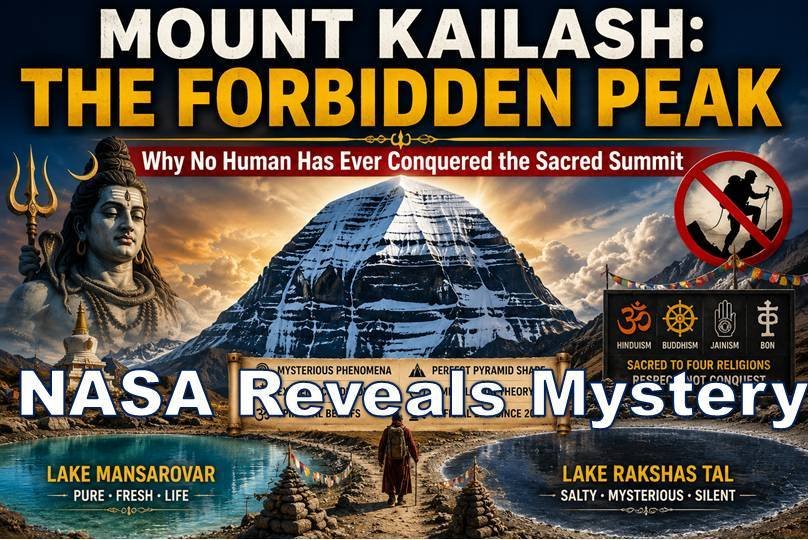
In a world where humans have conquered Mount Everest, reached the deepest parts of the oceans, and explored outer space, one mountain continues to stand untouched by human feet—Mount Kailash.
Located in the remote Tibetan Plateau at an altitude of approximately 6,638 meters, Mount Kailash is neither the tallest mountain in the Himalayas nor the most technically difficult. Yet, unlike Everest, no climber has ever officially stood on its summit.
For millions of believers, this is not merely a mountain. It is a sacred center of the universe, a divine abode, and a place where spirituality triumphs over human ambition.
But why has Mount Kailash remained unconquered? Is it due to religious reverence, extreme geography, mysterious phenomena, or a combination of all three?
Let us explore the fascinating mystery surrounding one of the world’s most sacred mountains.
The Mountain That No One Climbs
Mount Kailash rises dramatically from the barren Tibetan landscape, displaying an almost perfect pyramid-like shape.
Unlike most mountain peaks that have witnessed countless expeditions, Kailash remains untouched.
Over the decades, several explorers and climbers have considered attempting the summit, but every effort has either been abandoned or prohibited.
Today, climbing Mount Kailash is officially banned, making it one of the few major mountains on Earth that remains legally and spiritually protected.
Is Mount Kailash Really a Giant Pyramid?
One of the most controversial theories emerged in 1999 when Russian researcher Ernst Muldashev led an expedition to the region.
After studying the mountain, he proposed a sensational theory:
The Pyramid Theory
According to Muldashev:
- Mount Kailash is not a natural mountain.
- It is the world’s largest man-made pyramid.
- The structure may be hollow.
- Ancient advanced civilizations may have constructed it.
- Underground tunnels may connect Kailash with ancient sites in Egypt and Mexico.
The mountain’s remarkable symmetry and alignment with the cardinal directions contributed to these claims.
What Does Science Say?
While the pyramid theory attracted global attention, geologists strongly disagree.
According to modern geological research:
- Mount Kailash consists primarily of sedimentary rock.
- It was formed millions of years ago during the collision of the Indian and Eurasian tectonic plates.
- Wind, ice, and water erosion gradually carved the mountain into its present pyramid-like shape.
Scientists compare its appearance to the Matterhorn in the Alps, another mountain known for its striking geometric profile.
No scientific evidence supports the theory that Kailash is artificial.
The Mystery of Time: Does Time Move Faster at Kailash?
Perhaps the most intriguing claim associated with Mount Kailash is the so-called “time dilation” phenomenon.
During his expedition, Muldashev claimed that members of his team experienced unusually rapid growth of hair and nails.
According to him:
- Hair growth accelerated significantly.
- Nails appeared to grow faster than normal.
- Biological aging seemed unusually rapid.
These observations led to speculation that Kailash might function as a mysterious “time machine.”
The Story of the Four Siberian Climbers
One of the most dramatic legends associated with the mountain describes four Siberian climbers.
According to the story:
- They attempted to approach the summit.
- Shortly after returning, they began aging rapidly.
- Within a short period, all allegedly died from premature aging.
This story became widely circulated among mystery enthusiasts.
Scientific Reality Behind the Time Dilation Theory
Despite its popularity, there is no scientific evidence supporting the time-warp hypothesis.
Scientists point out that:
- Einstein’s Theory of Relativity requires enormous gravitational forces or near-light-speed travel to affect time.
- Mount Kailash does not possess the mass necessary to distort spacetime.
- No verified medical records support accelerated aging claims.
- Investigations found no credible evidence of the alleged Siberian expedition.
Researchers believe many such stories are myths, exaggerations, or misunderstandings fueled by the mountain’s mystical reputation.
Why Do Climbers Experience Strange Feelings Near Kailash?
Many visitors report unusual experiences around Mount Kailash:
- Feeling disoriented
- Hearing unexplained sounds
- Seeing visions
- Experiencing an overwhelming urge to turn back
Science offers a simpler explanation.
High Altitude Effects
At elevations exceeding 4,000 meters:
- Oxygen levels drop dramatically.
- Altitude sickness becomes common.
- Hallucinations and disorientation can occur.
- Fatigue affects judgment and perception.
These factors can create experiences that feel supernatural.
The Fascinating Tale of Two Sacred Lakes
Near Mount Kailash lie two neighboring lakes that present one of nature’s most remarkable contrasts:
Lake Mansarovar
Known as one of the holiest lakes in the world:
- Freshwater lake
- Crystal-clear blue water
- Rich aquatic life
- Associated with purity and spiritual cleansing
Hindu tradition holds that it was created from the mind of Lord Brahma.
Lake Rakshas Tal
Just a few kilometers away lies a dramatically different lake:
- Saline water
- Little or no aquatic life
- Often associated with darkness in mythology
- Crescent-shaped appearance
Because it has no natural outlet, minerals accumulate over centuries, making the water highly saline.
Science Behind the Contrast
The difference between the lakes is not supernatural.
Mansarovar
- Receives fresh glacial water.
- Has natural drainage channels.
- Salt accumulation remains low.
Rakshas Tal
- Has no outlet.
- Water evaporates but minerals remain.
- Salinity increases continuously.
Together, these lakes symbolize the balance between life and death, purity and power.
Why Did Reinhold Messner Refuse to Climb Kailash?
Perhaps the most significant moment in Kailash’s modern history came in 1985.
The Chinese authorities reportedly offered legendary mountaineer Reinhold Messner permission to climb the mountain.
Messner declined.
His reasoning was simple but profound.
He believed that conquering Kailash would deeply hurt the religious sentiments of millions of people.
According to Messner, some mountains should be respected rather than conquered.
His decision remains one of the most powerful endorsements of preserving sacred landscapes.
The Sacred Mountain of Four Religions
Mount Kailash occupies a unique place in human civilization because it is sacred to four major faiths.
Hinduism
For Hindus:
- Kailash is the abode of Lord Shiva and Goddess Parvati.
- It represents the center of spiritual energy.
- Pilgrims perform the sacred Kailash Parikrama.
The Legend of Ravana
According to Hindu mythology, Ravana once attempted to lift Mount Kailash. Lord Shiva effortlessly pinned him beneath the mountain with a single toe, demonstrating divine supremacy.
Buddhism
In Tibetan Buddhism:
- Kailash represents a sacred mandala.
- It is associated with Chakrasamvara (Demchok).
- Pilgrims perform circumambulation as an act of devotion.
The Legend of Milarepa
Tibetan folklore states that the Buddhist saint Milarepa became the only human to reach the summit.
Legend says he ascended using a beam of sunlight during a spiritual contest.
No historical evidence exists for this claim, but it remains one of Tibet’s most cherished stories.
Jainism
For Jains the mountain is known as Ashtapad. It is associated with the first Tirthankara, Rishabhdev. It is believed to be the site where he attained Moksha.
Bon Religion
The ancient Bon faith considers Kailash is a cosmic pillar. It also believed as a celestial staircase. It is worshipped as the meeting point of heaven, earth, and the underworld.
Why Climbing Kailash Is Considered a Sin
Despite differences in beliefs, all four religions share one common principle:
The Summit Belongs to the Divine
Followers believe:
- Gods reside on the summit.
- Human footsteps would desecrate sacred ground.
- Spiritual respect is more important than physical conquest.
As a result, pilgrims do not attempt to climb the mountain.
Instead, they walk around it in a sacred circumambulation known as Parikrama or Kora.
Why China Banned Climbing Mount Kailash
Following protests and objections from religious communities across India, Nepal, Tibet, and other countries, the Chinese government officially prohibited climbing expeditions to Mount Kailash in 2001.
The decision effectively ended all future attempts to summit the mountain.
Today, Kailash remains one of the world’s few untouched sacred peaks.
Conclusion: The Mystery That May Never Be Solved
The true mystery of Mount Kailash may not lie in alien civilizations, time machines, or hidden tunnels.
Its greatest mystery is its ability to inspire humility.
In an age where humanity seeks to conquer every frontier, Kailash reminds us that some places derive their power precisely because they remain untouched.
Whether viewed through the lens of science, religion, history, or mythology, Mount Kailash continues to stand as a symbol of reverence, wonder, and the enduring limits of human ambition.
Perhaps the greatest achievement is not reaching the summit—but understanding why it should remain untouched.