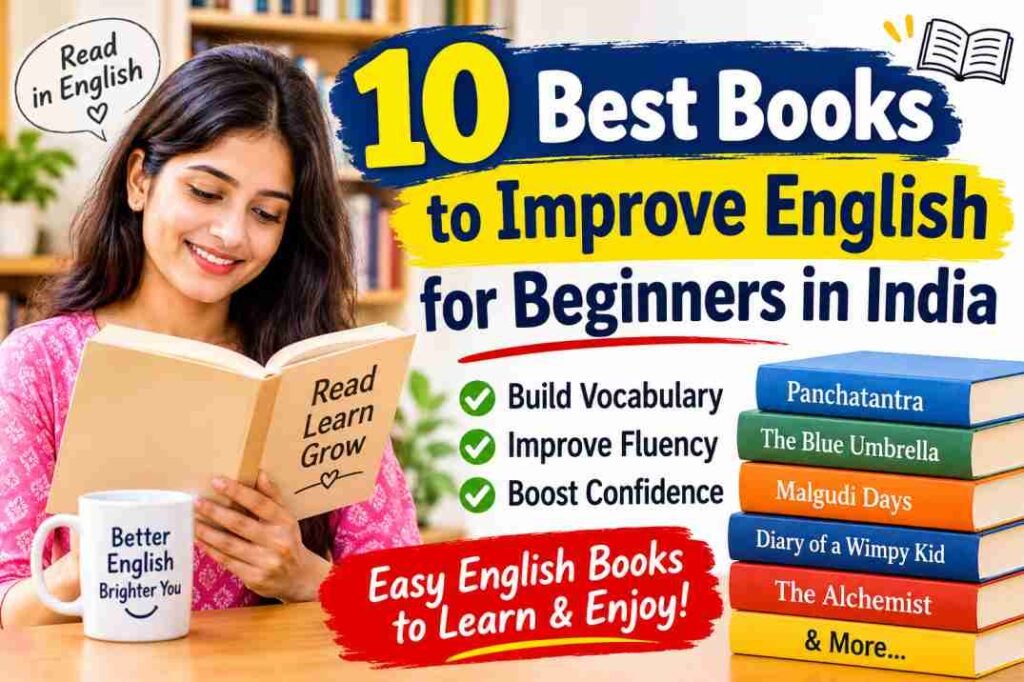
10 Best Books to Improve English for Beginners in India
Are you a beginner who wants to improve your English but doesn’t know which books to start reading? Do you sometimes feel that English novels are too difficult, full of unfamiliar words, or simply too lengthy to finish?
If your answer is yes, you are not alone.
One of the most effective and enjoyable ways to improve your English naturally is through regular reading. However, choosing the right books is equally important. Many beginners make the mistake of starting with complicated novels or books containing advanced vocabulary. As a result, they quickly lose interest and confidence.
The secret is to start with simple, interesting and easy-to-understand English books that gradually develop your reading ability.
Whether you are a school student, college student, working professional, homemaker or someone preparing for competitive examinations, reading the right books can help you improve your English vocabulary, sentence formation, comprehension, grammar and spoken English.
In this article, we have selected 10 excellent English books by Indian and international authors that are particularly suitable for beginners in India. These books are enjoyable, relatively easy to understand and provide an excellent starting point for developing a regular English reading habit.
Let’s explore them one by one.
Why Should Beginners Read English Books to Improve Their Language Skills?
Reading is not just a hobby. It is also a powerful language-learning activity.
When you read English books regularly, you gradually become familiar with how sentences are structured, how words are used in different situations and how ideas are expressed naturally.
Here are some important benefits:
- Improves vocabulary: You encounter new words and learn their meanings through context.
- Develops sentence formation: Regular reading helps you understand how grammatically correct sentences are constructed.
- Improves reading fluency: You gradually become faster and more comfortable reading English.
- Enhances comprehension: You learn to understand paragraphs, stories and complex ideas.
- Helps spoken English: Reading aloud and retelling stories can improve your speaking ability.
- Builds confidence: As your reading improves, your fear of English gradually decreases.
Most importantly, reading should be enjoyable. You do not need to begin with difficult literary classics. Start with books that interest you.
Top 10 Best Books to Improve English for Beginners
Here is our list of 10 recommended books, arranged from beginner-friendly selections to books that offer a slightly greater language challenge.
10. Panchatantra
Absolute Beginner
- Author: Traditionally attributed to Vishnu Sharma
- Genre: Moral stories and fables
- Best for: Basic vocabulary and simple sentences
Panchatantra is an excellent starting point for absolute beginners. Most Indian readers are already familiar with these stories in their mother tongue. Therefore, understanding them in English becomes much easier.
The stories are short, interesting and filled with useful everyday vocabulary. You can also practise retelling each story in your own words, which is an excellent way to improve spoken English.
9. The Blue Umbrella
Beginner
- Author: Ruskin Bond
- Genre: Fiction
- Best for: Descriptive vocabulary and reading fluency
This beautiful short novel is an excellent choice for beginners. Ruskin Bond uses simple, clear and engaging English to tell a story set in the Indian hills.
Since the setting and characters feel familiar to Indian readers, it is easier to connect with the story. The book helps develop descriptive vocabulary, sentence flow and reading confidence.
8. Malgudi Days
Beginner
- Author: R. K. Narayan
- Genre: Short stories
- Best for: Comprehension and sentence formation
Malgudi Days is particularly suitable for Indian English learners. Its stories portray everyday Indian life through interesting characters and relatable situations.
As it is a collection of short stories, you can read one story every day without feeling pressured to finish an entire novel.
It is an excellent book for improving comprehension, storytelling ability and natural English expression.
7. Diary of a Wimpy Kid
Beginner
- Author: Jeff Kinney
- Genre: Comedy and illustrated fiction
- Best for: Conversational English and everyday expressions
If you get bored while reading traditional books, this is an excellent alternative.
The book combines simple English with entertaining illustrations, making it easier for beginners to understand the story.
It introduces readers to conversational English, informal expressions and everyday vocabulary. Its humorous storytelling also makes reading enjoyable rather than feeling like a classroom exercise.
6. How I Taught My Grandmother to Read and Other Stories
Beginner
- Author: Sudha Murty
- Genre: Inspirational short stories
- Best for: Basic vocabulary and emotional expressions
Sudha Murty is one of the most popular Indian authors for readers who prefer simple and meaningful storytelling.
Her writing style is clear, straightforward and easy to follow. The stories are relatable and often carry valuable life lessons.
This book is particularly helpful for beginners who want to improve their English without struggling with complicated vocabulary.
5. The Magic of the Lost Temple
Beginner to Pre-Intermediate
- Author: Sudha Murty
- Genre: Adventure and children’s fiction
- Best for: Reading habits and vocabulary development
Another wonderful book by Sudha Murty, this novel offers an engaging story with relatively simple English.
Its interesting chapters and easy storytelling make it suitable for young readers and adults who are beginning their English reading journey.
It is a good choice for developing consistency and confidence in reading.
4. The Room on the Roof
Pre-Intermediate
- Author: Ruskin Bond
- Genre: Coming-of-age fiction
- Best for: Descriptive English and sentence flow
The Room on the Roof is another beautiful novel by Ruskin Bond. His writing is smooth, descriptive and engaging.
Although beginners may encounter a few unfamiliar words, the overall narrative is accessible to readers who have developed basic English reading skills.
The book helps improve descriptive vocabulary, emotional expressions and the ability to understand longer passages.
3. Charlotte’s Web
Beginner
- Author: E. B. White
- Genre: Children’s fiction
- Best for: Basic grammar patterns and vocabulary
Charlotte’s Web is a timeless and heartwarming story that is loved by readers across generations.
Its relatively simple language, clear conversations and memorable characters make it an excellent choice for English beginners.
Readers can learn useful vocabulary, common sentence structures and conversational expressions while enjoying the story.
2. The Secret Seven Series
Beginner to Pre-Intermediate
- Author: Enid Blyton
- Genre: Mystery and adventure
- Best for: Reading speed and common English expressions
If you enjoy mystery and adventure, the Secret Seven series is an excellent option.
The stories are engaging, the chapters are relatively short, and the language is generally accessible to young readers and English learners.
The suspense keeps you interested, encouraging you to read more. This helps develop reading speed, comprehension and familiarity with everyday English expressions.
1. The Alchemist
Pre-Intermediate and Above
- Author: Paulo Coelho
- Genre: Inspirational fiction and philosophy
- Best for: Vocabulary, sentence patterns and reflective reading
The Alchemist is one of the most widely read inspirational novels in the world.
Its storytelling is engaging, and its language is generally accessible compared with many literary classics. However, some philosophical expressions and ideas may require a little extra effort from beginners.
The book encourages readers to think about their dreams, ambitions and personal journeys. It is a wonderful choice for improving reading ability while enjoying an inspirational story.
Other Useful Books to Improve English: Grammar, Vocabulary and Competitive Examination Preparation
Apart from novels and storybooks, some reference books can help you strengthen your English grammar and vocabulary.
If your objective is not only to read English but also to write correctly, speak confidently and prepare for competitive examinations, consider the following books.
Descriptive English – Oswaal Books
Useful for improving writing skills, comprehension and descriptive answers, particularly for examination preparation.
A Handbook of English Grammar – Oswaal Books
A useful reference for learning grammar rules and practising grammatical concepts through exercises.
Objective General English
Helpful for competitive examination preparation, including banking, SSC and other recruitment examinations. Choose an edition appropriate to your examination.
Vocabulary Builder – Oswaal Books
Helps learners develop vocabulary through thematic word lists, idioms, phrasal verbs and practice exercises.
These books can be used alongside storybooks to develop a stronger foundation in English grammar and vocabulary.
More Interesting English Books for Intermediate and Advanced Readers
Once you become comfortable reading simple English books, you can gradually move towards more challenging novels and non-fiction books.
Here are some additional recommendations.
| Book | Author | Suggested reading level |
| You Can Win | Shiv Khera | Intermediate |
| Ikigai | Héctor García and Francesc Miralles | Intermediate |
| Discover Your Destiny | Robin Sharma | Advanced |
| The Monk Who Sold His Ferrari | Robin Sharma | Intermediate |
| Train to Pakistan | Khushwant Singh | Intermediate to Advanced |
| And the Mountains Echoed | Khaled Hosseini | Upper-Intermediate |
| The Girl in Room 105 | Chetan Bhagat | Intermediate |
| If It’s Not Forever | Durjoy Datta and Nikita Singh | Intermediate |
These books offer different reading experiences, including motivation, romance, history, philosophy and fiction.
A useful suggestion: Do not rush to buy advanced books. Develop your reading habit first and gradually increase the difficulty level.
3 Practical Tips to Improve English Through Reading
Buying good books is only the first step. The real improvement comes from how regularly and effectively you read them.
Here are three practical techniques that can make your reading practice much more effective.
Tip 1: Don’t Try to Understand Every Single Word
This is one of the biggest mistakes made by English beginners.
Many learners stop after every sentence to search for unfamiliar words in a dictionary. This interrupts the reading process and often makes reading frustrating.
Instead:
- Read the complete paragraph first.
- Try to understand the overall meaning.
- Underline unfamiliar but useful words.
- Look up only important words.
- Try to understand new vocabulary from the context.
Remember, you do not need to understand every word to understand a story.
Gradually, you will become familiar with more words and expressions.
Tip 2: Read, Record and Review
This is one of the most effective exercises for improving spoken English through reading.
Follow these simple steps:
- Read one page or a short story.
- Close the book.
- Explain the story in your own English.
- Record your explanation using your smartphone.
- Listen to your recording.
- Identify mistakes in pronunciation, grammar and sentence formation.
Try this exercise every day.
Initially, you may struggle to express your thoughts. Do not worry. With regular practice, you will gradually become more comfortable speaking English.
Tip 3: Read While Listening to Audiobooks
If an audiobook version is available, try listening while following the printed text.
This technique helps you:
- Learn correct pronunciation.
- Understand natural speaking patterns.
- Improve listening comprehension.
- Develop better reading fluency.
- Become familiar with English intonation and rhythm.
It is particularly useful for learners who understand written English but struggle to speak confidently.
A Simple 30-Day English Reading Practice Plan for Beginners
If you are serious about improving your English, follow this simple 30-day routine.
| Period | Daily activity | Objective |
| Days 1–7 | Read 2–3 pages of an easy storybook | Develop reading habits |
| Days 8–14 | Read 4–5 pages and identify 5 useful words | Improve vocabulary |
| Days 15–21 | Read aloud and record yourself | Improve pronunciation |
| Days 22–30 | Read a short story and explain it in your own words | Develop speaking confidence |
Spend approximately 20–30 minutes every day on this activity.
Do not worry about making mistakes. Consistency is much more important than perfection.
Which English Books Should You Choose According to Your Level?
If you are still confused about where to begin, use this simple guide.
| Your English level | Recommended books |
| Absolute Beginner | Panchatantra, Tinkle, Champak |
| Beginner | The Blue Umbrella, Charlotte’s Web, Malgudi Days |
| Beginner to Pre-Intermediate | Diary of a Wimpy Kid, Secret Seven, Sudha Murty books |
| Intermediate | The Alchemist, The Monk Who Sold His Ferrari, You Can Win |
| Upper-Intermediate | And the Mountains Echoed, Train to Pakistan |
| Advanced | Discover Your Destiny and more challenging literary works |
Remember that these are approximate reading levels. Your experience will depend on your existing vocabulary, reading ability and the particular edition of the book.
Frequently Asked Questions (FAQs)
1. Which is the best book to improve English for absolute beginners?
Panchatantra is an excellent starting point because its stories are familiar to many Indian readers and are available in simple English editions. The Blue Umbrella and Charlotte’s Web are also good options.
2. Can reading English novels improve spoken English?
Yes. Regular reading helps you develop vocabulary, sentence formation and familiarity with natural English expressions. However, reading alone may not be sufficient. Combine reading with speaking, listening and recording exercises to improve spoken fluency.
3. Which Indian authors are best for English beginners?
Sudha Murty, Ruskin Bond and R. K. Narayan are excellent choices. Their stories often feature relatable Indian settings and engaging characters, making them suitable for many English learners.
4. How many pages should I read daily to improve my English?
If you are a beginner, start with 2–3 pages daily. Gradually increase your reading to 5–10 pages as your confidence improves. Regular practice is more important than the number of pages.
5. Should I use a dictionary while reading English books?
Yes, but avoid searching for every unfamiliar word. First try to understand the meaning from the context. Use a dictionary for important words that repeatedly appear or are essential to understanding the passage.
6. Are children’s storybooks useful for adults learning English?
Absolutely! Children’s books often use simple vocabulary, shorter sentences and engaging illustrations. There is no age limit for learning English. Adults can benefit greatly from starting with easy storybooks.
7. Can I improve my English by reading aloud?
Yes. Reading aloud helps you practise pronunciation, sentence rhythm and fluency. It also makes you more comfortable speaking English. Combine it with recording and listening to your own voice for better results.
Final Thoughts: Start Reading Today and Improve Your English Naturally
Improving English is not something that happens overnight. It requires patience, regular practice and the right learning materials.
You do not need expensive courses or complicated grammar books to begin your journey. A simple storybook, 20–30 minutes of daily reading and a willingness to learn can make a significant difference over time.
Start with books that you genuinely enjoy. If you like adventure, choose Secret Seven. If you enjoy inspirational stories, try The Alchemist. If you prefer Indian stories, explore the wonderful writings of Sudha Murty, Ruskin Bond and R. K. Narayan.
Most importantly, don’t be afraid of making mistakes. Every page you read, every new word you learn and every sentence you speak brings you one step closer to your goal.
Remember: Don’t just read English to finish a book. Read English to understand, think, express and communicate better.
Now tell us in the comments:
- Which of these books have you already read?
- Which book would you recommend to someone learning English?
- Would you like us to prepare another list of the best English books for intermediate and advanced learners?
Happy Reading and Happy Learning!