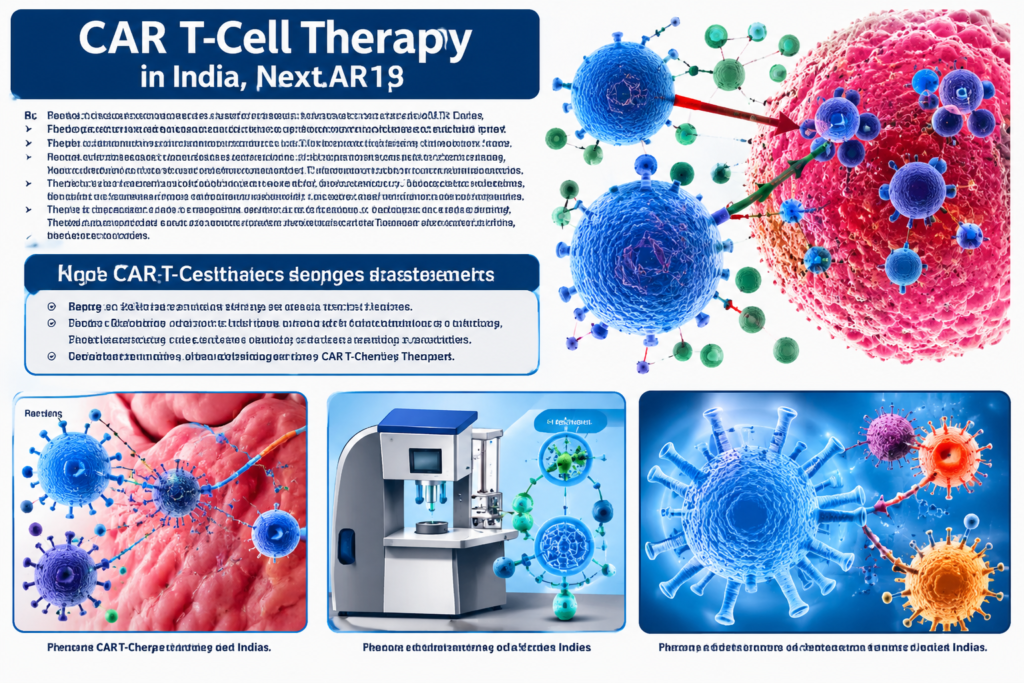
CAR T-Cell Therapy is one of the most advanced developments in modern cancer treatment. It is a form of immunotherapy that uses a patient’s own immune cells to identify and destroy cancer cells. India has also made significant progress in this field with the development of NexCAR19, an indigenous CAR T-cell therapy developed through a collaboration between IIT Bombay and Tata Memorial Centre.
For students preparing for competitive examinations such as UPSC, SSC CGL, CDS, CAPF, State PCS and other government examinations, CAR T-cell therapy is an important topic from General Science, Biology, Biotechnology and Current Affairs.
This article explains the meaning of cancer, its causes and symptoms, methods of diagnosis, different cancer treatments and the working mechanism of CAR T-cell therapy, along with important facts about India’s NexCAR19 initiative.
What Is Cancer?
Cancer is a group of diseases characterised by the uncontrolled and abnormal growth and division of cells in the human body.
Normally, cell division takes place in a controlled manner. It is essential for two major functions:
- Growth and development of the human body.
- Repair and maintenance of damaged or dead cells.
For example, when a person suffers a minor cut or wound, new cells are produced to replace damaged cells. Similarly, during childhood, cell division helps the body grow.
However, when genetic changes or mutations disturb the normal mechanisms controlling cell growth and division, certain cells may begin multiplying uncontrollably. These abnormal cells can form a mass known as a tumour and, in some cases, spread to other parts of the body.
Important examination point: Cancer involves uncontrolled cell growth and division, often associated with genetic mutations.
What Causes Cancer?
Cancer does not have a single cause. It can develop due to genetic factors, environmental exposure, lifestyle choices and other biological processes.
Some important risk factors include:
Smoking and tobacco consumption: Tobacco is a major preventable cause of cancer. Cigarettes, bidis, chewing tobacco, gutkha and other tobacco products contain carcinogenic substances that can damage DNA and increase cancer risk.
Alcohol consumption: Alcohol is associated with an increased risk of several cancers.
Ultraviolet (UV) radiation: Excessive exposure to ultraviolet radiation from sunlight can damage skin-cell DNA and increase the risk of skin cancer.
Ionising radiation: Certain forms of radiation, including X-rays and gamma rays, can damage DNA. Medical imaging procedures are generally performed with appropriate safety measures because the benefits usually outweigh the small radiation risks.
Carcinogenic chemicals: Exposure to certain chemicals, including benzene, asbestos and other industrial carcinogens, can increase cancer risk.
Air pollution and environmental pollutants: Long-term exposure to certain pollutants is associated with an increased risk of cancer.
Genetic mutations: Some people inherit genetic changes that increase their susceptibility to particular cancers. Other mutations develop during a person’s lifetime.
Certain infections: Human papillomavirus (HPV), hepatitis B virus (HBV), hepatitis C virus (HCV) and some other infections are associated with specific cancers.
Obesity, unhealthy diet and physical inactivity: These factors can contribute to the risk of developing certain types of cancer.
It is important to understand that not every person exposed to a risk factor develops cancer, and cancer can also occur in people who have no obvious risk factors.
Common Symptoms and Warning Signs of Cancer
Cancer symptoms depend on the organ affected and the type of cancer. Some cancers may not produce noticeable symptoms during their early stages.
Important warning signs include:
- Unexplained weight loss: Significant weight loss without changes in diet or physical activity.
- Unusual lump or swelling: A new lump in the breast, neck, abdomen or another part of the body.
- Persistent fatigue: Continuous tiredness or weakness without an obvious explanation.
- Unusual bleeding: Blood in urine, stool, sputum or abnormal vaginal bleeding.
- Persistent cough: A cough or hoarseness that does not improve.
- Changes in bowel or bladder habits: Persistent constipation, diarrhoea or difficulty passing urine.
- Difficulty swallowing: Persistent discomfort or difficulty while swallowing food.
- Changes in skin: A changing mole, unusual pigmentation or a wound that does not heal.
- Persistent pain: Pain that continues without an identifiable cause.
An unexplained weight loss of around 5–10% of body weight can be a warning sign, but it does not automatically mean that a person has cancer.
Important: These symptoms can also occur in non-cancerous conditions. Their presence does not establish a cancer diagnosis. Medical evaluation is necessary when symptoms persist or are unusual.
How Is Cancer Diagnosed?
Cancer diagnosis involves clinical examination, laboratory investigations, imaging and, where appropriate, examination of tissue samples.
One of the most important diagnostic procedures is the Biopsy Test.
What Is a Biopsy?
A biopsy is a medical procedure in which a small sample of tissue or cells is collected from a suspected abnormal area and examined under a microscope.
The procedure generally involves the following steps:
Sample Collection: A doctor collects tissue from the suspected area. Depending on the location, this may involve a needle biopsy, endoscopy-guided biopsy or surgical biopsy.
Sample Preservation and Transportation: The collected sample is handled and preserved appropriately before being examined in a pathology laboratory.
Laboratory Examination: The tissue is processed, often embedded in paraffin wax, cut into very thin sections, stained and examined under a microscope by a pathologist.
Diagnosis: The pathologist evaluates the cells and tissue architecture to determine whether the abnormality is benign, malignant or requires further investigation.
Other diagnostic methods include:
- Mammography: Breast imaging, generally performed using low-dose X-rays, to identify suspicious abnormalities.
- CT Scan: Provides detailed cross-sectional images of internal organs.
- MRI: Uses magnetic fields and radio waves to produce detailed images.
- Ultrasound: Uses sound waves to examine internal organs and tissues.
- Endoscopy: Allows doctors to examine internal organs using a camera-equipped instrument.
- Blood Tests: Help assess blood-cell counts, organ function and certain tumour markers.
A blood test alone generally cannot confirm or rule out cancer. The choice of diagnostic investigation depends on the suspected cancer.
Difference Between Benign and Malignant Tumours
A tumour is an abnormal mass of tissue. Tumours may be benign or malignant.
| Benign Tumour | Malignant Tumour |
| Non-cancerous | Cancerous |
| Usually grows locally | Can invade nearby tissues |
| Does not metastasise | Can spread to distant organs |
| Often has well-defined boundaries | May invade surrounding structures |
| Usually easier to manage | Requires cancer-specific treatment |
A benign tumour may still require treatment if it presses on an important organ or causes other complications.
A malignant tumour is cancerous and requires appropriate medical evaluation and treatment.
What Is Metastasis?
Metastasis is the process through which cancer cells spread from their original location to other parts of the body.
For example, breast cancer may initially develop in breast tissue. If cancer cells spread through the blood or lymphatic system to the lungs, liver, bones or brain, the condition is known as metastatic breast cancer.
Two important terms for competitive examinations are:
- Localised Cancer: Cancer remains confined to its original location or limited region.
- Metastatic Cancer: Cancer has spread from its original site to distant parts of the body.
Metastatic cancer is generally more difficult to treat than cancer detected at an early stage. However, treatment options and outcomes vary considerably depending on the cancer type and its response to therapy.
Major Types of Cancer: Important General Knowledge
Cancer can develop in different tissues and organs. Some important classifications are given below.
| Type of Cancer | Meaning |
| Carcinoma | Cancer arising from epithelial cells |
| Sarcoma | Cancer arising from bone, muscle, fat, blood vessels or other connective tissues |
| Leukaemia | Cancer of blood-forming tissues, commonly involving abnormal white blood cells |
| Lymphoma | Cancer originating in the lymphatic system |
| Myeloma | Cancer of plasma cells |
| Melanoma | Cancer arising from pigment-producing melanocytes, commonly affecting the skin |
Important Terms Related to Cancer
Oncology: The branch of medicine concerned with the study, diagnosis and treatment of cancer.
Haematological Cancer: Cancer affecting blood, bone marrow or the lymphatic system.
Leukaemia: A type of blood cancer involving abnormal blood-forming cells, often resulting in the production of abnormal white blood cells.
Myeloma: Cancer of plasma cells, which are a type of white blood cell responsible for producing antibodies.
Sarcoma: A cancer that develops in connective or supporting tissues, including bones and muscles.
Melanoma: A potentially aggressive cancer that develops from melanocytes, the cells responsible for producing melanin.
Carcinoma: A broad category of cancer originating in epithelial tissues. Examples include breast, lung, prostate and many skin cancers.
World Cancer Day: Observed every year on 4 February to raise awareness about cancer prevention, early detection and treatment.
Examination note: Leukaemia, lymphoma and myeloma are different categories of haematological malignancies. They should not be treated as interchangeable terms.
Major Methods of Cancer Treatment
The primary objective of cancer treatment is to destroy or control cancer cells while minimising damage to healthy tissues.
The treatment method depends on the cancer type, stage, location, patient’s health and other clinical factors.
Surgery
Surgery involves removing cancerous tissue from the body.
For example, if a breast tumour is localised and suitable for surgical removal, doctors may recommend breast-conserving surgery or mastectomy, depending on the clinical situation.
Surgery is commonly used for solid tumours but is not suitable for every type of cancer.
Radiotherapy
Radiotherapy uses high-energy radiation to damage the DNA of cancer cells and prevent them from growing and dividing.
Some radiotherapy techniques use external radiation beams, while others involve placing radioactive sources inside or near the tumour.
Historically, Cobalt-60 has been an important source of gamma radiation used in cancer radiotherapy.
Modern radiotherapy also uses advanced technologies such as:
- Linear Accelerator (LINAC)
- Intensity-Modulated Radiation Therapy (IMRT)
- Image-Guided Radiation Therapy (IGRT)
- Stereotactic Radiotherapy
Radiotherapy is carefully planned to deliver radiation to the target area while protecting surrounding healthy tissues as much as possible.
Chemotherapy
Chemotherapy involves using medicines to destroy cancer cells or stop their growth and multiplication.
Many conventional chemotherapy medicines are classified as Cytotoxic Drugs.
The term cytotoxic can be understood as:
- Cyto = Cell
- Toxic = Harmful or poisonous
These medicines affect rapidly dividing cells. However, they may also damage certain healthy cells that divide rapidly.
This explains some common side effects of chemotherapy:
- Hair loss
- Nausea and vomiting
- Fatigue
- Reduced blood-cell counts
- Increased risk of infections
- Fertility-related complications in some patients
Certain cancer treatments can affect sperm production and ovarian function. Depending on the treatment and individual circumstances, doctors may discuss fertility preservation before starting therapy.
Immunotherapy
Immunotherapy is a treatment approach that helps the body’s immune system recognise and fight cancer.
Instead of relying only on medicines that directly attack rapidly dividing cells, immunotherapy uses or modifies immune mechanisms to target cancer.
CAR T-cell therapy is one of the important examples of this advanced treatment approach.
What Is CAR T-Cell Therapy?
Important Science & Technology Topic
CAR T-cell therapy stands for:
Chimeric Antigen Receptor T-Cell Therapy
- C – Chimeric
- A – Antigen
- R – Receptor
- T – T Cells
CAR T-cell therapy is an advanced form of immunotherapy and gene-modified cell therapy used to treat certain cancers.
It involves collecting a patient’s own immune cells, modifying them genetically in a specialised laboratory and returning the modified cells to the patient’s body.
The purpose is to enable these modified immune cells to recognise and attack cancer cells more effectively.
What Are T Cells?
T cells are a type of white blood cell (WBC) that play an important role in the human immune system.
They are produced from haematopoietic stem cells in the bone marrow and mature in the thymus gland.
Their functions include:
- Identifying infected or abnormal cells.
- Helping coordinate immune responses.
- Destroying certain infected or abnormal cells.
- Supporting the body’s defence against diseases.
In CAR T-cell therapy, these T cells are genetically modified to recognise a specific target, known as an antigen, present on cancer cells.
What Does Chimeric Antigen Receptor Mean?
To understand the term, consider its three components.
Chimeric: Something formed by combining components from different sources.
Antigen: A molecule or structure that can be recognised by the immune system.
Receptor: A specialised protein structure that recognises and binds to a particular target.
In CAR T-cell therapy, scientists introduce genetic instructions into T cells so that they produce a specially designed receptor on their surface.
This receptor enables the modified T cells to recognise a particular antigen on cancer cells.
How Does CAR T-Cell Therapy Work? Step-by-Step Process
CAR T-cell therapy is a personalised treatment because the patient’s own immune cells are generally used to prepare the therapy.
The process involves several important stages.
Step 1: Collection of Patient’s Blood
First, blood is collected from the patient through a specialised procedure known as leukapheresis.
This procedure separates and collects white blood cells, including T cells, from the blood.
The remaining blood components are returned to the patient.
Step 2: Isolation of T Cells
The collected white blood cells are processed in a specialised laboratory to isolate the required T cells.
These cells will be used to manufacture the personalised CAR T-cell product.
Step 3: Genetic Modification
The isolated T cells are genetically modified to introduce instructions for producing Chimeric Antigen Receptors (CARs).
These receptors are designed to recognise specific antigens present on the target cancer cells.
For example, NexCAR19 targets the CD19 antigen found on B cells, including many B-cell cancer cells.
Step 4: Multiplication of Modified T Cells
After genetic modification, the CAR T cells are multiplied in a controlled laboratory environment.
This process is known as cell expansion.
A sufficient number of modified cells are prepared for administration to the patient.
Step 5: Preparation of the Patient
Before CAR T-cell infusion, patients generally receive a short course of lymphodepleting chemotherapy.
This helps create favourable conditions for the infused CAR T cells to expand and function.
Step 6: Infusion of CAR T Cells
The prepared CAR T-cell product is administered to the patient through an intravenous infusion.
These modified cells enter the bloodstream and circulate through the body.
Step 7: Recognition and Destruction of Cancer Cells
The CAR receptors on the modified T cells recognise and attach to the target antigens on cancer cells.
Once activated, CAR T cells can multiply, release immune signals and destroy the targeted cancer cells.
The most important point: CAR T-cell therapy does not simply introduce an ordinary cancer medicine into the body. It modifies the patient’s own immune cells so that they can specifically recognise and attack targeted cancer cells.
The process is described by the National Cancer Institute as the collection of T cells, genetic engineering, expansion in the laboratory and reinfusion into the patient.
NCI+1
CAR T-Cell Therapy vs Conventional Chemotherapy
| Basis | Chemotherapy | CAR T-Cell Therapy |
| Treatment approach | Uses anti-cancer medicines | Uses genetically modified immune cells |
| Main target | Often affects rapidly dividing cells | Targets cells carrying a specific antigen |
| Source | Manufactured medicines | Usually patient’s own T cells |
| Preparation | Drug preparation and administration | Cell collection, genetic modification and expansion |
| Administration | Usually multiple treatment cycles | Often a single CAR T-cell infusion |
| Side effects | Nausea, hair loss, fatigue, low blood counts | Cytokine release syndrome, neurological effects and other complications |
| Application | Many types of cancer | Specific cancers for which an appropriate CAR T-cell product is approved |
CAR T-cell therapy is not a replacement for chemotherapy in every patient. Both treatments have different applications and may also be used as part of a broader treatment strategy.
CAR T-Cell Therapy in India: NexCAR19
India’s Indigenous Innovation
India achieved a significant milestone in cancer treatment with the development of its first indigenous CAR T-cell therapy, known as NexCAR19.
NexCAR19 was developed through a collaboration involving:
- Indian Institute of Technology (IIT) Bombay.
- Tata Memorial Centre, Mumbai.
- ImmunoACT, a biotechnology company originating from IIT Bombay.
The research and development involved scientists, researchers and medical professionals working together to develop an affordable CAR T-cell therapy for Indian patients.
Important Dates and Developments
- 2015 onwards
IIT Bombay and Tata Memorial Centre began collaborative efforts towards developing indigenous CAR T-cell technology.
- March 2021
Regulatory approval was obtained to conduct Phase I clinical trials.
- October 2023
NexCAR19 received marketing authorisation from India’s Central Drugs Standard Control Organisation (CDSCO).
- 4 April 2024
President of India Droupadi Murmu launched NexCAR19 at IIT Bombay and dedicated the therapy to the nation.
Which Cancers Can NexCAR19 Treat?
NexCAR19 is a CD19-directed CAR T-cell therapy. It is designed for certain types of B-cell malignancies.
Its approved indications include:
- B-cell Acute Lymphoblastic Leukaemia (B-ALL).
- B-cell Non-Hodgkin Lymphoma (B-NHL).
It is important to understand that NexCAR19 is not a universal treatment for every type of cancer. It is designed to target CD19, which is expressed on B cells and many B-cell malignancies.
NSE India Archives+1
What Is the Cost of NexCAR19 in India?
One of the most important features of NexCAR19 is its comparatively lower cost.
At the time of its launch in April 2024, the reported price of the therapy was approximately ₹40 lakh per patient.
International CAR T-cell treatments can cost several crores of rupees, depending on the product, country and treatment arrangements.
Reported cost comparison at the time of launch
NexCAR19 – India
₹40 lakh
Overseas CAR T therapies
Several crores
Indicative historical launch-period figures, not a current hospital quotation. Total treatment expenditure may include additional medical and hospital costs.
The lower cost of indigenous technology is an important achievement for India’s biotechnology and healthcare sectors.
However, even ₹40 lakh remains beyond the financial capacity of many ordinary families. Costs of preliminary investigations, hospitalisation, monitoring and management of complications may add to the total expenditure.
Advantages of CAR T-Cell Therapy
CAR T-cell therapy offers several potential advantages over conventional treatment approaches.
Personalised Treatment: It generally uses the patient’s own immune cells, making it a personalised treatment.
Targeted Action: CAR receptors are designed to recognise specific antigens present on target cancer cells.
Advanced Immunotherapy: It uses the patient’s immune system rather than relying exclusively on conventional anti-cancer medicines.
Potential for Durable Response: In selected patients, CAR T-cell therapy can produce deep and long-lasting responses.
Reduced Dependence on Imported Technology: Indigenous products such as NexCAR19 strengthen India’s domestic biotechnology and advanced healthcare capabilities.
Potentially Lower Cost: Indigenous manufacturing can improve affordability compared with certain imported CAR T-cell products.
Limitations and Side Effects of CAR T-Cell Therapy
Despite its potential, CAR T-cell therapy is a complex treatment and is not free from risks.
Some important complications include:
Cytokine Release Syndrome (CRS): This is one of the major complications associated with CAR T-cell therapy. It occurs when activated immune cells release large quantities of cytokines into the bloodstream.
Symptoms may include:
- High fever.
- Headache.
- Nausea.
- Rapid heartbeat.
- Low blood pressure.
- Breathing difficulties.
Severe cases may become life-threatening and require urgent medical intervention.
Neurological Toxicity: Some patients may experience confusion, difficulty speaking, altered consciousness, seizures or other neurological complications.
Infections: Treatment can weaken immune defences and increase the risk of infections.
Low Blood-Cell Counts: Patients may experience prolonged reductions in certain blood-cell types.
High Treatment Cost: Even indigenous CAR T-cell therapy remains expensive for many Indian families.
Limited Applications: Different CAR T-cell products target different antigens and are approved for specific cancer types. Not every cancer patient is eligible.
The NexCAR19 prescribing information specifically highlights cytokine release syndrome, infections, cytopenia and other potential complications.
ImmunoACT+2
Important Developments: Qartemi and India’s CAR T-Cell Research
NexCAR19 is not the only indigenous development in this field.
Another Indian CAR T-cell therapy product is Qartemi, reflecting the progress of domestic research and manufacturing in advanced cell and gene therapies.
The Government of India has also highlighted support through biotechnology research programmes and initiatives aimed at making advanced therapies more accessible.
Press Information Bureau+1
Important General Knowledge Questions for Competitive Examinations
The following facts are particularly useful for UPSC, SSC CGL, CDS, CAPF, Railway and State PCS examinations.
| Question | Answer |
| What is CAR T-cell therapy? | Chimeric Antigen Receptor T-cell Therapy |
| CAR T-cell therapy belongs to which category? | Immunotherapy and gene-modified cell therapy |
| Which cells are used? | T lymphocytes |
| T cells belong to which category? | White Blood Cells |
| Where do T cells mature? | Thymus gland |
| What is an antigen? | A structure recognised by the immune system |
| What is a receptor? | A structure that recognises and binds to a specific target |
| What is oncology? | Study and treatment of cancer |
| What is a biopsy? | Collection and examination of tissue or cells |
| What is metastasis? | Spread of cancer to distant parts of the body |
| What is a malignant tumour? | A cancerous tumour |
| What is a benign tumour? | A non-cancerous tumour |
| What is radiotherapy? | Treatment using ionising radiation |
| Which radioactive isotope has been used in radiotherapy? | Cobalt-60 |
| What are cytotoxic drugs? | Drugs that damage or destroy cells |
| Which plant is a source of vincristine and vinblastine? | Catharanthus roseus (Madagascar periwinkle) |
| What is World Cancer Day? | 4 February |
| What is NexCAR19? | India’s indigenous CD19-directed CAR T-cell therapy |
| Which institutions collaborated in developing NexCAR19? | IIT Bombay and Tata Memorial Centre, with ImmunoACT |
| Who launched NexCAR19? | President Droupadi Murmu |
| When was NexCAR19 launched? | 4 April 2024 |
| Which organisation approved NexCAR19? | CDSCO |
| What is the target antigen of NexCAR19? | CD19 |
Important Scientific Clarifications for Students
Some commonly circulated explanations about cancer can be misleading. Remember these scientifically important points:
- Stress can affect general health, but it should not be described as a proven direct cause of cancer.
- Not every food preservative is carcinogenic. Specific chemicals and exposure levels matter.
- Microplastics are being investigated for possible health effects, but it is not scientifically established that ordinary exposure to microplastics directly causes cancer in humans.
- Sunscreens are used to protect against harmful UV radiation. There is no scientific basis for claiming that sunscreen generally causes cancer.
- A high white blood cell count does not automatically mean leukaemia. Infection and inflammation can also increase WBC counts.
- A low WBC count does not automatically indicate HIV or cancer.
- PCOS/PCOD is not the same as ovarian cancer.
- Copper or bronze utensils, antioxidants and particular foods should not be presented as guaranteed methods of preventing cancer.
Cancer prevention is best supported by avoiding tobacco, limiting alcohol, maintaining a healthy lifestyle, getting recommended vaccinations such as HPV and hepatitis B, reducing exposure to known carcinogens and participating in appropriate screening programmes.
Conclusion
CAR T-cell therapy represents a major advancement in modern medical science. It has changed the way certain blood cancers can be treated by using genetically modified immune cells to recognise and destroy cancer cells.
India’s NexCAR19 is an important achievement in indigenous biotechnology, demonstrating how collaboration between educational institutions, hospitals and biotechnology companies can bring advanced medical treatment closer to Indian patients.
For competitive examination aspirants, this topic is important because it connects Biology, Biotechnology, Medical Science, General Knowledge and Current Affairs.
For the general public, the most important message is that early diagnosis, appropriate medical consultation and access to evidence-based treatment remain essential in the fight against cancer.
SEO Details for ESM Info Club
SEO Title: CAR T-Cell Therapy in India: NexCAR19, Cost, Process, Benefits & Cancer Treatment
Suggested URL Slug: car-t-cell-therapy-india-nexcar19
Meta Description: Learn about CAR T-Cell Therapy, its working process, benefits, side effects and India’s indigenous NexCAR19 cancer treatment. Important GK facts for UPSC, SSC and CDS.
Focus Keyword: CAR T-Cell Therapy in India
Secondary Keywords:
- What is CAR T-cell therapy
- NexCAR19 therapy cost in India
- India’s first CAR T-cell therapy
- Chimeric Antigen Receptor T-cell therapy
- Cancer treatment in India
- Immunotherapy for cancer
- IIT Bombay CAR T-cell therapy
- Tata Memorial Centre cancer treatment
- Cancer symptoms and diagnosis
- Types of cancer and treatment
Suggested WordPress Tags: CAR T Cell Therapy, NexCAR19, Cancer Treatment, Immunotherapy, Biotechnology, IIT Bombay, Tata Memorial Centre, Medical Science, General Science, Competitive Exams
Official and Reference Sources
- Press Information Bureau – President launches India’s first home-grown CAR T-cell therapy
- IIT Bombay – NexCAR19 launch and development
- Ministry of Health – Government initiatives on CAR T-cell therapy
- NexCAR19 official prescribing information
- World Health Organization – Cancer
- National Cancer Institute – How CAR T Cells Work
Disclaimer: This article is intended for educational and general awareness purposes, including competitive examination preparation. It is not a substitute for professional medical advice, diagnosis or treatment. CAR T-cell therapy must be considered only by qualified cancer specialists after evaluating the patient’s medical condition and eligibility.