
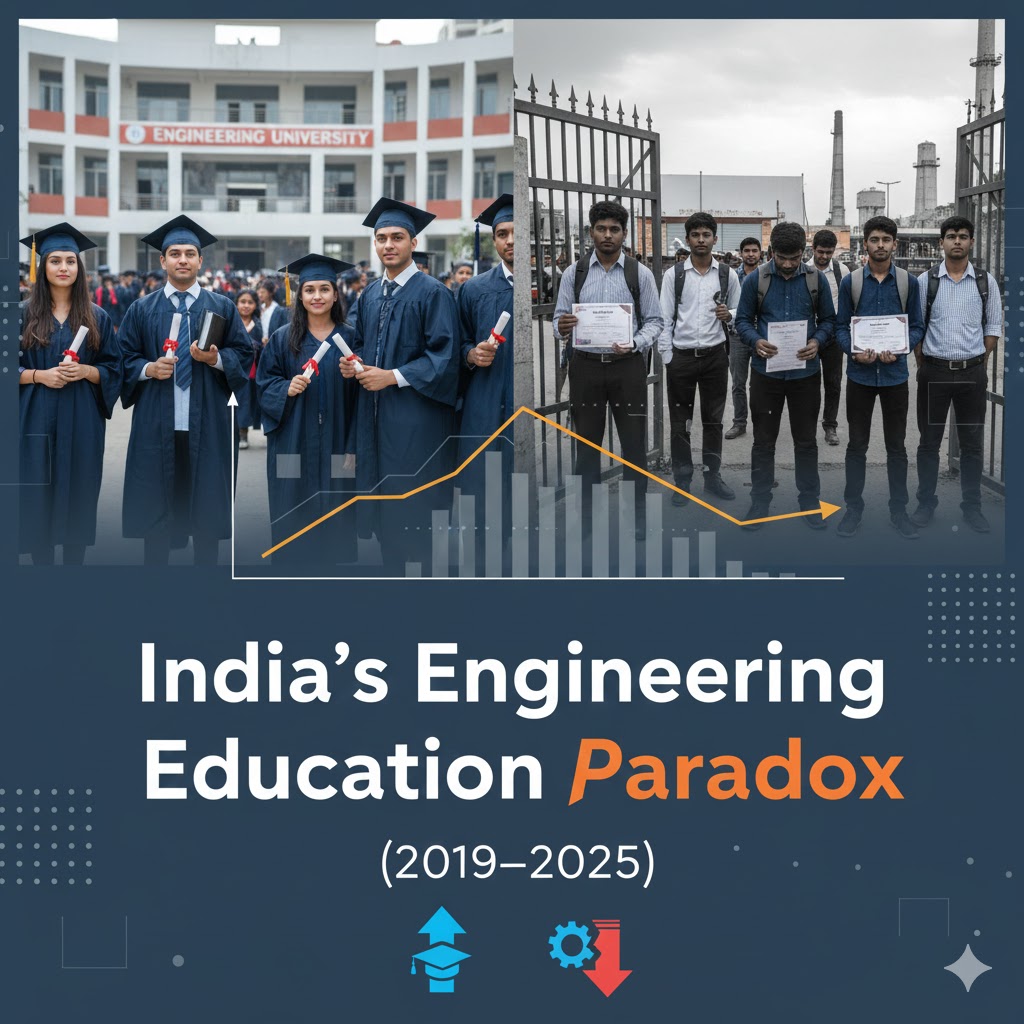
Degrees in Abundance, Employability in Crisis — and the Urgent Need for Skill Development Institutions
Introduction: The Middle-Class Aspiration Trap
For decades, the Indian middle class has been driven by a singular educational aspiration for their children:
“Engineer or Doctor.”
While the medical profession remains constrained by limited MBBS and PG seats, engineering education has taken the opposite trajectory. A massive private-sector boom in technical education since the early 2000s has created an unlimited supply of engineering seats, far exceeding industry demand.
The result is a paradox:
- Medical aspirants fail due to seat scarcity
- Engineering graduates fail due to lack of employability
This article examines the real employment outcomes of engineering graduates, the structural flaws in engineering education, and why India urgently needs specialised skill development schools that operate parallel to colleges — especially in Tier-2 and Tier-3 cities beyond Bengaluru.
Engineering Graduate Output: The Hard Numbers (2019–2024)
Degree Production vs Employment Reality
Based on AICTE and AISHE data, India produces:
- ~8–9 lakh B.E./B.Tech graduates annually
- Over 1.5 million technical graduates if diplomas are included
However, placement and employability paint a far more sobering picture.
Engineering Graduate Statistics (AICTE / AISHE)
| Academic Year | B.E./B.Tech Passed Out | Placement Rate | Approx. Placed | Unemployment / Skill Gap |
| 2019–20 | ~8,00,000 | 61.2% | ~4,89,000 | ~15% |
| 2020–21 | ~8,30,000 | 62.0% | ~5,14,000 | ~12.9% |
| 2021–22 | 8,47,000 | 62.9% | ~5,32,000 | ~12.4% |
| 2022–23 | ~8,70,000 | 80.9% | ~7,03,000 | ~18.1% (skill gap) |
| 2023–24 | ~9,00,000 (est.) | 75–80% | ~6,75,000 | ~13.8% |
Key Insight:
While placement percentages look encouraging on paper, placement ≠ employability.
The Critical Distinction: Unemployment vs Unemployability
1. Unemployment (PLFS Perspective)
According to the Periodic Labour Force Survey (PLFS):
- Youth unemployment (15–29 years): 12%–18%
- Engineers often appear “employed” statistically
2. Unemployability (Industry Perspective)
Industry reports (NASSCOM, Aspiring Minds, India Skills Report) reveal a more uncomfortable truth:
- Only ~20–25% engineers are industry-ready
- Up to 75–80% lack job-relevant skills
- Many “placed” graduates earn ₹10,000–₹20,000/month, far below a dignified professional threshold
👉 This aligns exactly with your observation:
Only ~20% get standard placements capable of sustaining a respectable livelihood.
Why Engineering Colleges Are Failing Students
1. Unlimited Seats, Declining Quality
- Private colleges expanded rapidly
- Faculty shortages
- Poor lab infrastructure
- Outdated curriculum
2. Theory-Heavy, Practice-Poor Education
Most colleges still focus on:
- Exams
- Memorisation
- Obsolete syllabi
Missing entirely:
- Real-world projects
- Production-level coding
- Industrial tools
- Version control, DevOps, cloud exposure
3. Final Year Is Wasted
Ironically, the final year, when students are most capable of skill-building, is consumed by:
- Low-quality projects
- Placement anxiety
- Internships without learning value
Placement Reality: The Salary Truth
Salary Distribution (Indicative)
| Category | Approx. Share |
| High-quality placements (₹6–12 LPA) | 15–20% |
| Average IT/BPO roles (₹3–4 LPA) | 25–30% |
| Low-skill / support roles (<₹2.5 LPA) | 30–35% |
| Unplaced / informal work | 15–20% |
This explains why engineering no longer guarantees social mobility.
The 2025 Outlook: Hiring Winter & Structural Shift
IT Slowdown (2024–25)
Major IT firms (TCS, Infosys, Wipro, Cognizant) have:
- Reduced fresher intake by 10–15%
- Delayed onboarding
- Increased automation
Where Jobs Are Shifting
- Global Capability Centres (GCCs)
- Startups (with skill-first hiring)
- Product companies
- Data, AI, Cloud, Cybersecurity roles
Degrees alone no longer matter. Skills do.
Job Scope Beyond Bengaluru: City-wise Reality Check
1. Kolkata
- Growing GCC presence
- FinTech, Data Services, BFSI tech roles
- Demand for Python, SQL, Power BI, Cloud
2. Delhi NCR
- SaaS startups
- Product companies
- Cybersecurity, DevOps, Full-stack roles
3. Mumbai
- FinTech, Media-Tech
- Data Analytics, Backend Engineering
- High demand, high skill threshold
4. Jaipur
- IT services, ERP, startup ecosystem
- Strong scope for web development & QA
5. Vadodara
- Industrial IT
- Automation, ERP, IoT integration
6. Guwahati
- Government IT, PSU-linked tech
- Data entry to analytics transition roles
7. Lucknow & Patna
- EdTech, GovTech, Service IT
- Rising demand for entry-level skilled engineers
8. Thiruvananthapuram
- Strong IT parks (Technopark)
- Product engineering, embedded systems
👉 Opportunity exists everywhere — but only for skilled candidates.
The Only Viable Solution: Dedicated Skill Development Schools
What India Urgently Needs
A new category of institutions:
Skill Development Schools for Engineering Graduates
Core Characteristics
- Entry during final year or immediately after graduation
- Industry-designed curriculum
- 70% practical, 30% theory
- Mandatory live projects
- Internship + work experience model
Skill Focus Areas
- Full Stack Development
- Data Analytics & AI
- Cloud & DevOps
- Cybersecurity
- ERP (SAP, Oracle)
- Industrial Automation & IoT
Outcome
- Engineers become employable, not just educated
- Colleges regain relevance through partnerships
- Industry gets job-ready talent
Conclusion: Degree Is No Longer Enough
India does not suffer from a lack of engineers.
It suffers from a lack of skilled engineers.
Unless:
- Skill-building is integrated into the final year
- Independent skill development schools scale nationally
- Practical work experience becomes mandatory
…the engineering degree risks becoming the new general arts degree — respected socially, but weak economically. The future belongs not to degree-holders, but to skill-holders.